From PDF to serious game: what AI really speeds up
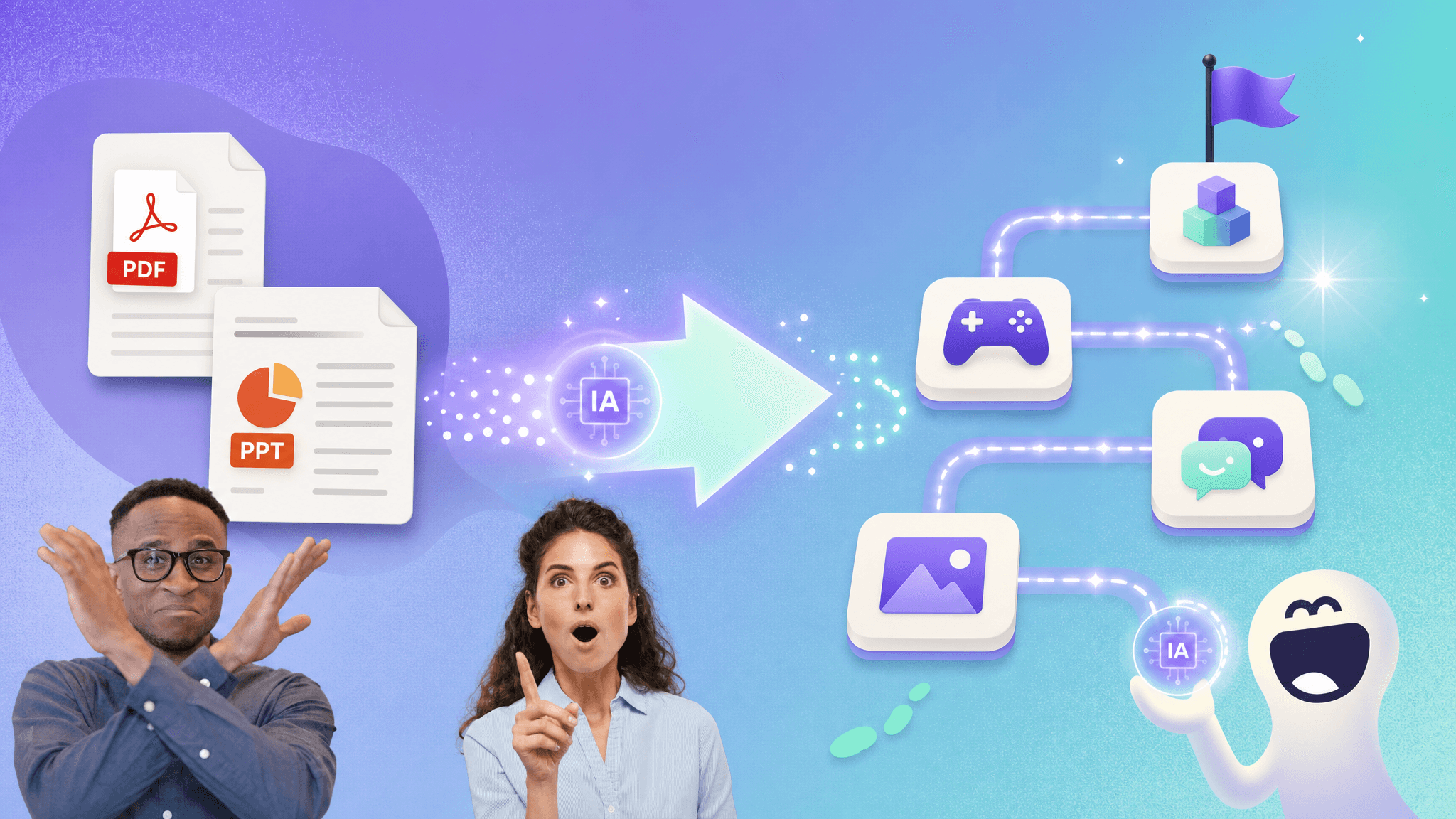
A training PDF can contain everything you need: concepts, rules, examples, procedures, sometimes even practical cases.
The problem is that a PDF does not play with you.
It scrolls. It waits. It assumes the learner will read in the right order, remember the right details, connect the dots alone and stay focused until the end. Real training situations are rarely that neat.
So when teams use AI to create a training game, the easy reflex is obvious: upload the material, ask for twenty questions, publish a quiz.
It is fast. It is not yet a serious game.
A serious game starts when the content becomes a journey. The learner does not only read information. They act, make mistakes, receive feedback, try again, compare, unlock, choose, explore an image, reorder steps or solve a situation.
AI can speed up that transformation. It should not decide it alone.
The real topic is not question generation
A quiz can be useful. It checks a concept, brings attention back, gives a score that is easy to understand.
But if the whole journey is just a chain of quiz questions, the PDF has mostly been moved into another format. It looks more interactive, without necessarily helping people learn better.
The right question is not: “How many questions can AI generate?”
The right question is: “What should the player do to understand, remember and apply this content?”
From there, the source material becomes raw material. You can cut information into shorter steps, identify key moments, turn definitions into decisions, procedures into ordering tasks, common mistakes into feedback, diagrams into interactive images.
That is where AI becomes useful: it helps you avoid copy-paste training.
What AI can actually speed up
In Ludiz, AI can help teams move faster from an idea to a first playable journey: structuring a module, rewriting content, suggesting steps, proposing mechanics, preparing feedback or generating images.
That is not a promise of fully autonomous creation. And that is a good thing.
A good training game still needs an author. Someone has to check the level, vocabulary, business examples, sensitive messages, progression and learning accuracy.
AI is valuable because it produces a first version you can read, test and improve. It saves time on the draft. The human keeps control of meaning.
Concretely, AI can help to:
- identify key concepts in a PDF or PPT;
- suggest a more digestible learning order;
- turn long sections into short steps;
- vary formats between quiz, sorting, interactive image, matching, challenge or open question;
- write feedback that is more useful than “correct” or “incorrect”;
- generate visual directions that make a situation clearer.
The gain is not only speed. It is the ability to create a base that is easier to adjust.
From “training material” to “playable journey”
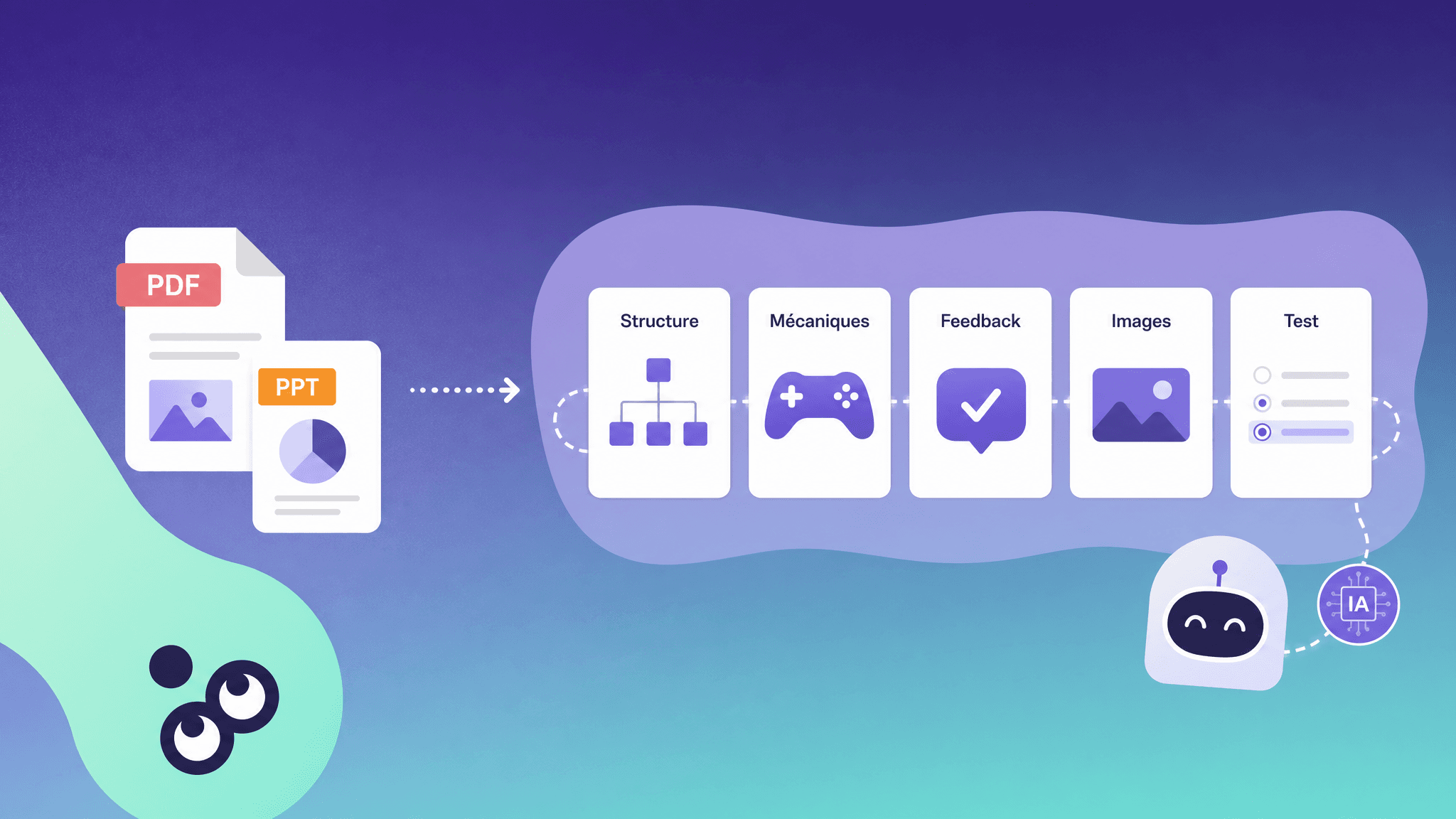
The transformation can be thought of as five building blocks.
First, structure. You split the content into short steps, each with a clear role: introduce, make the learner act, check, correct, conclude.
Then, mechanics. A definition can become a true/false step. A procedure can become a sorting activity. A technical image can become a zone to explore. A scenario can become a decision.
Then comes feedback. This is often the neglected part. Useful feedback does not only say whether the learner is right. It explains why, corrects the mistake and points back to the right reasoning.
Images come next. They are not there to decorate. They can show a situation, guide attention, make a step more memorable or replace a paragraph that is too heavy.
Finally, testing. Before sharing the journey, you need to play it. Too long? Too easy? A vague instruction? Feedback that arrives too late? A mechanic that adds nothing? Testing reveals what the document does not show.
A simple example: an internal procedure
Take a training document about an internal procedure. In the PDF, there is an introduction, several steps, exceptions, mistakes to avoid and a summary page.
A lazy conversion would create ten comprehension questions.
A more useful conversion could look like this:
- a short context step to set the situation;
- a sorting activity to put the procedure in the right order;
- an interactive image to identify the right elements in a document or interface;
- a scenario choice to handle an exception;
- detailed feedback on common mistakes;
- a final mini-test to validate the essentials.
The source content is the same. The experience is not.
The player does not only prove they have read. They show they know what to do.
Keep author control
AI can suggest a mechanic that looks appealing but does not serve the objective. It can make text smoother while removing an important business nuance. It can generate feedback that sounds correct but is too vague to help someone progress.
That is why the editor still matters.
The author must be able to review every step: change a mechanic, rewrite an instruction, add an image, simplify feedback, adjust scoring, test the mobile experience, export to SCORM if the game needs to live inside an LMS.
AI speeds up the start. The editor makes the result usable.
It also avoids the “automatic quiz” trap. The goal is not to produce more questions. The goal is to produce an experience that can be reviewed, played, corrected and owned.
What to check before publishing
Before sharing an AI-assisted journey, a few checks make a big difference.
Does the journey follow a logical progression? Does every step have a clear action? Are the mechanics varied for a reason? Does the feedback really help people understand? Do the visuals clarify the content? Does the game work on mobile? Is the level right for the audience?
Business checks matter too: vocabulary, examples, internal rules, compliance, sensitive messages, product or client names. AI can go fast. Validation still needs to be serious.
A good test is to let someone play the journey who did not help create it. If they understand the instructions, learn something and can explain what they remember, the game is starting to do its job.
A PDF does not become interactive just because people can click on it
Turning a PDF or PPT into a serious game is not about adding buttons around the content.
It is about deciding what people should do with that content.
AI helps you move faster from raw material to a first playable version. It suggests, rewrites, structures and illustrates. But the result becomes interesting when an author takes control again: choosing mechanics, adjusting tone, checking feedback and testing the journey before release.
The moment a PDF stops pretending to be interactive is the moment the learner becomes a player.
That is when the content starts to move.
For organizations that publish training in an LMS, creation is only part of the story. The journey can also be exported as SCORM and integrated into the existing learning environment: the Ludiz article on SCORM export